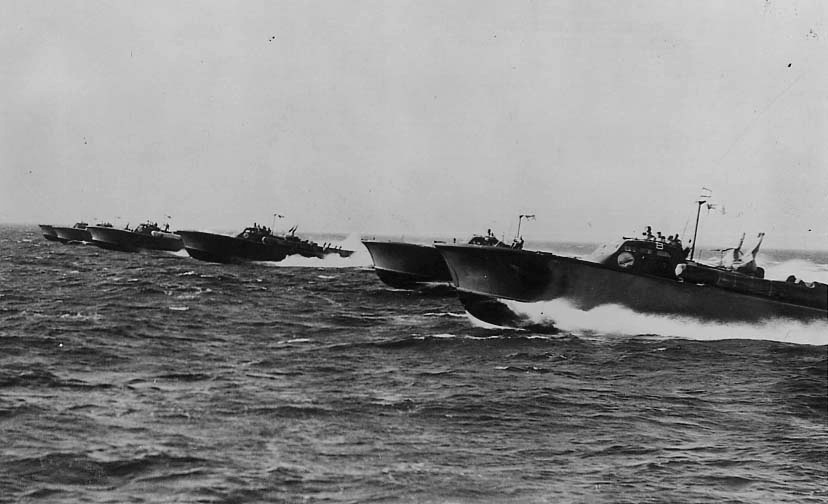
Of all the US motor torpedo boats built, the Electric Boat Company's 77-foot PT has always been a favorite of mine, with the Higgins 78' running a close second. Above are pictured several Elco 77's running in formation off of the East Coast. I originally saw this picture in 1980 when I bought a copy of Frank Johnson's "United States PT-Boats of World War II". The caption described the boats as being several of the Elco-77's numbered BPT (British PT) 1-10 that were sent to the Royal Navy under Lend-Lease. The caption also mentions that the boat in the foreground was BPT-8. Not knowing any better at the time, I accepted that explanation at face value...until I came across the picture below in the spring of 2001.
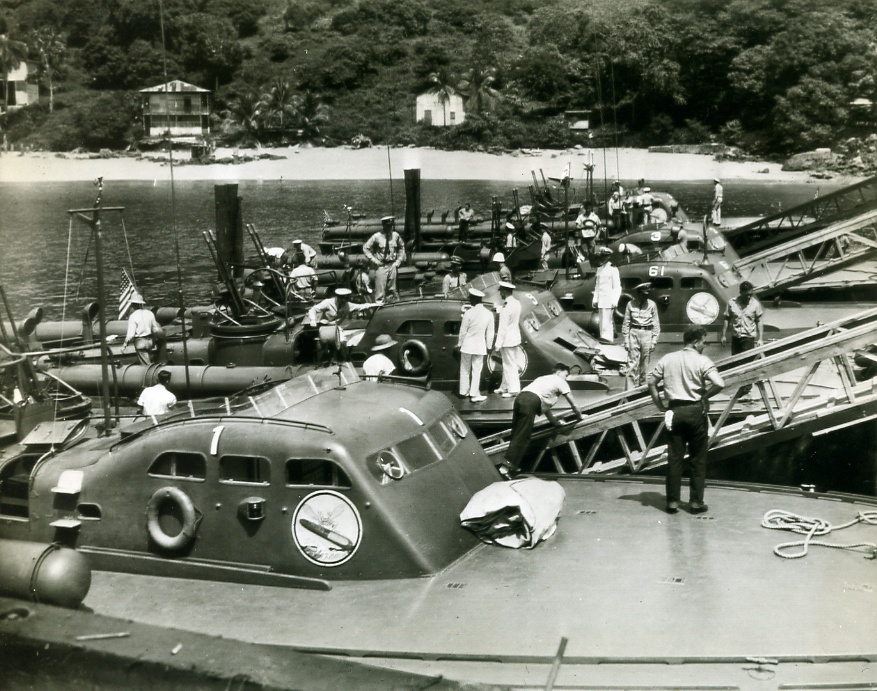
Above are several Elco 77's moored to the pier during commissioning ceremonies at the newly established motor torpedo boat base at Taboga, an island located ten miles off the Pacific side of the Panama Canal. This photograph in my possession is dated August 8 1942, but it was actually taken on August 1st. Note the boats numbered '1', '9', and '3'. The boat last in line, one can barely make out the number '2'. The only boat number that made any sense to me was PT 61, third in line. I also knew full well that PT's 1-8 were experimental boats of varying designs, none of which were built by Elco...while PT 9 was a 70' British Power Boat Company design that was purchased by Elco, and was the genesis of the American boat-building firm's 70' and 77' PT's. I began to wonder if there were any other pictures with similarly numbered 77-footers, and also figure out why they were numbered in this fashion. I did a little digging; sure enough, I found a few more.
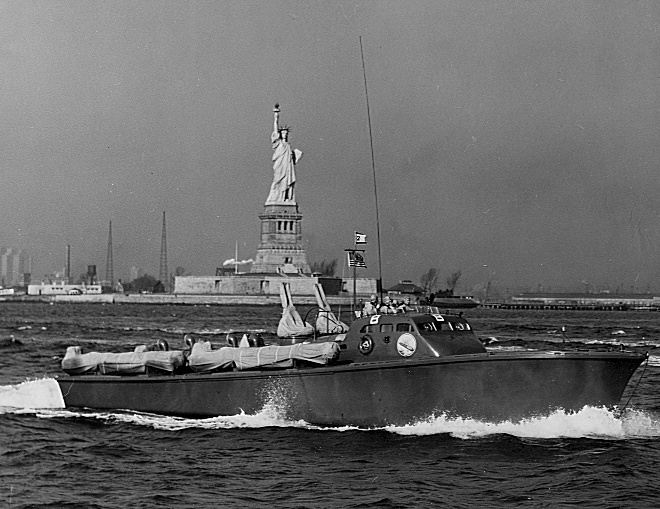
Above, 'PT 8'. Below, 'PT 10' These photos were taken off the US East Coast in November 1941, around the same time as the others. (National Archives)
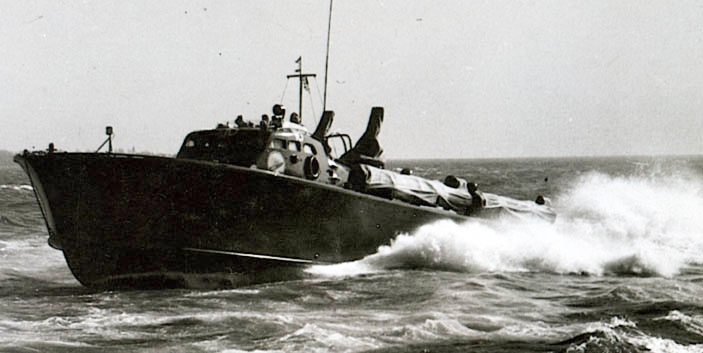

Above shows another shot of 'PT 8', with 'PT 2' to the left, in November 1941...unfortunately, I can't make out the numbers of the other boats. The '8' boat seems to be the most photographed boat in this group of images, probably because it is flying the pennant of the squadron commander. By the time I found these photos, I already knew these boats were Elco 77's belonging to MTB Squadron Two, commanded at the time by Lt. Earl S. Caldwell USN. The boats in the squadron at this time were PT's 36-40, and PT's 43-48. PT's 36, 37, 38, 39, 40, 43, and 44 belonged to the PT 20-44 series of 77-foot boats, while PT's 45-48 were of the PT 45-68 group--the main difference is in the cockpit-cabin section. On the PT 45-68 boats, the cabin profile was streamlined for better visibility.
Sometime prior to December 1941, the Navy Department decided to transport Squadron Two (still fitting out in the New York Navy Yard) to Panama in order to augment the defenses of the Canal Zone. Around this time, the numbers on the boats' cabins were changed. The eleven boats of the squadron were numbered 0-10; originally, my best guess at the order was:
#1-PT 46
#2-PT 45
#3-PT 48
#4-possibly PT 47
#5-PT 37
#6-possibly PT 36
#7-PT 38
#8-PT 39
#9-possibly PT 40
#10-PT 43
# 0-possibly PT 44
My reasoning was based on entries made in several boat logs--and I have been told that the PT boat logs can be somewhat unreliable. Frankly, I feel that depends on the diligence of each individual boat's quartermaster (the sailor responsible for keeping the log) and the boat captain (who signed off on it). One of the best kept logs was that of PT 44, when she was skippered by Lt. Frank Freeland USNR. From the time he reported aboard the 44 boat in the spring of 1942 until the boat's last preserved log (September 1942) Lieutenant Freeland's (or his quartermaster's) entries, while brief, gave me a few hints as to which boat may be which. A prime example of such an entry, dated 19 July 1942, is as follows:
Reid, W.L., TM1/c transferred to PT 10 for temporary duty.
Next thing to do was check each of the Squadron Two boat logs on that date to see which boat Torpedoman Reid reported to; it turned out Reid was transferred to PT 43 that day.
In regards to the 44 boat being numbered '0'--I have no explanation; the 44's log from March 1942 until July of that year the top of each page has this handwritten header: 'Log of the USS PT (0) of MTB Squadron Two'. On several pages it simply reads 'USS PT 44 (0)'.
PT 38's log also has this entry on November 11, 1941, written by the boat captain at the time (Lt. j/g Hugh M. Robinson USN):
“1045 Changed number on this vessel to -5- by order of ComMTBRon Two for tactical purposes.”
At that time, New York, with its harbors, docks, and yards, was a hotbed of German espionage activity (which the FBI was doing its level best to discover and eliminate). It is my speculation that Lieutenant Caldwell’s “tactical purposes” could also be deemed “security precautions”.
The two photos below are interesting:

"PT 7"--A late series (PT 45-68) Elco 77-footer at speed. Note the lack of guns. (PT Boats, Inc.)

A colorized photo of the crew of “PT 8” at Tulagi, sometime in 1942. (PT Boats, Inc.)
I’ve already pointed out that “PT 8” is actually PT 39—the “PT 7” must be PT 47, as PT’s 45, 46, and 48 (all later series Elco-77’s) have already been accounted for.
At any rate, by a closer examination of the logs in the National Archives, and by close examination of these photographs, this is my revised boat list:
#0-PT 44
#1-PT 46
#2-PT 45
#3-PT 48
#4-possibly PT 37
#5-PT 38
#6-possibly PT 36
#7-PT 47
#8-PT 39
#9-possibly PT 40
#10-PT 43
The boats remained numbered in this fashion until the summer of 1942. In May 1942 Squadron Two expanded to 14 boats with the arrival of PT's 59, 60, and 61 from MTB Squadron Four at Melville. None of these new boats had been assigned any new numbers...yet. In July, a new MTB Squadron Three was created (due to the destruction of the original squadron in the Philippines in April). Going to the new squadron were PT's 46 (#1), 45 (#2), 48 (#3), 37 (#4), 38 (#5), 39 (#8), along with PT's 60 and 61.
The new Squadron Three was heading for the South Pacific; all the original boats in the new squadron retained their original security numbers except for PT 38--it was renumbered "7". The two new boats, PT's 60 and 61, were given the numbers "6" (PT 60) and "5" (PT 61). According to a letter sent to me by former Squadron Three CO Hugh Robinson, this was to mislead any Japanese agents that may have been operating in the Canal Zone area.
As for the boats that remained with Squadron Two--PT's 36 (#6), 40 (#9), 43 (#10), 44 (#0), and 47 (#4) reverted back to their original numbers, and (along with PT 59) had them painted in black on their cabins per new regulations from the Navy Department regarding the displaying of insignia and designators on motor torpedo boats. The logs of PT 44, PT tender USS Jamestown, tankers USS Lackawanna and USS Tappahannock, and PC 476 yielded much information, as well as a photograph of PT 47 being unloaded from a transport ship at Noumea in November 1942.
Much of what I have written here is pure speculation on my part; but I'm sure I am on the right track. Even with the information I’ve found, I’m far from satisfied, and probably never will be. But I do think that this mystery should be solved, for these photos of the boats with these numbers have contributed (in their own small way) to the proliferation of much PT boat misinformation in print and on the Internet. It appears the “tactical purposes” of MTB Squadrons Two and Three are still working, even after 70 years.
A final question--how did each boat get the number assigned to it? I’m afraid that answer is lost to history; my own belief is that they were chosen at random. When doing historical research on events that happened decades ago, the participants in those events can most likely remember broad, general things, but trivial minutiae can be (in most cases) a little difficult, if not impossible. Also remember those same participants are in the twilight of their lives, so we as researchers should be lucky and grateful for the information we do recieve.
I do not expect this explanation to be the last word...so if anyone else has anything of substance to add to this discussion, kindly send me a note at PT_King@yahoo.com and let's chat about it.
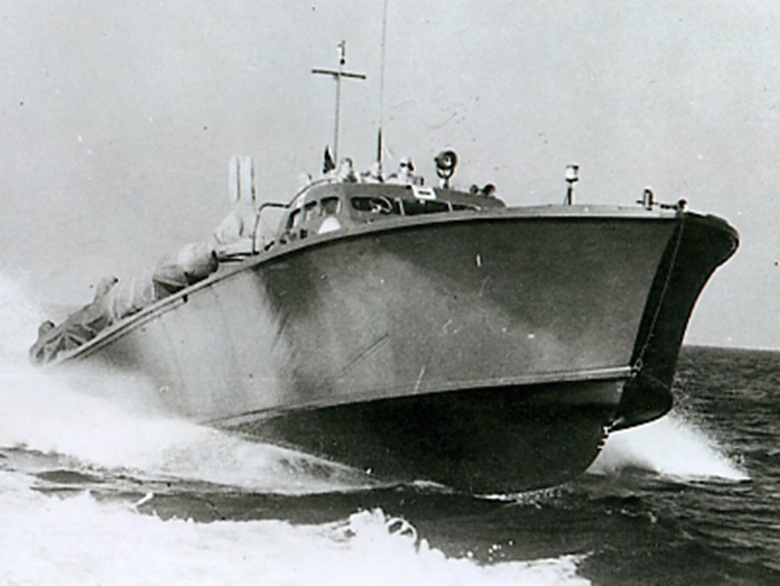
PT 39 (or 'PT 8', if you prefer), November 1941 (National Archives)
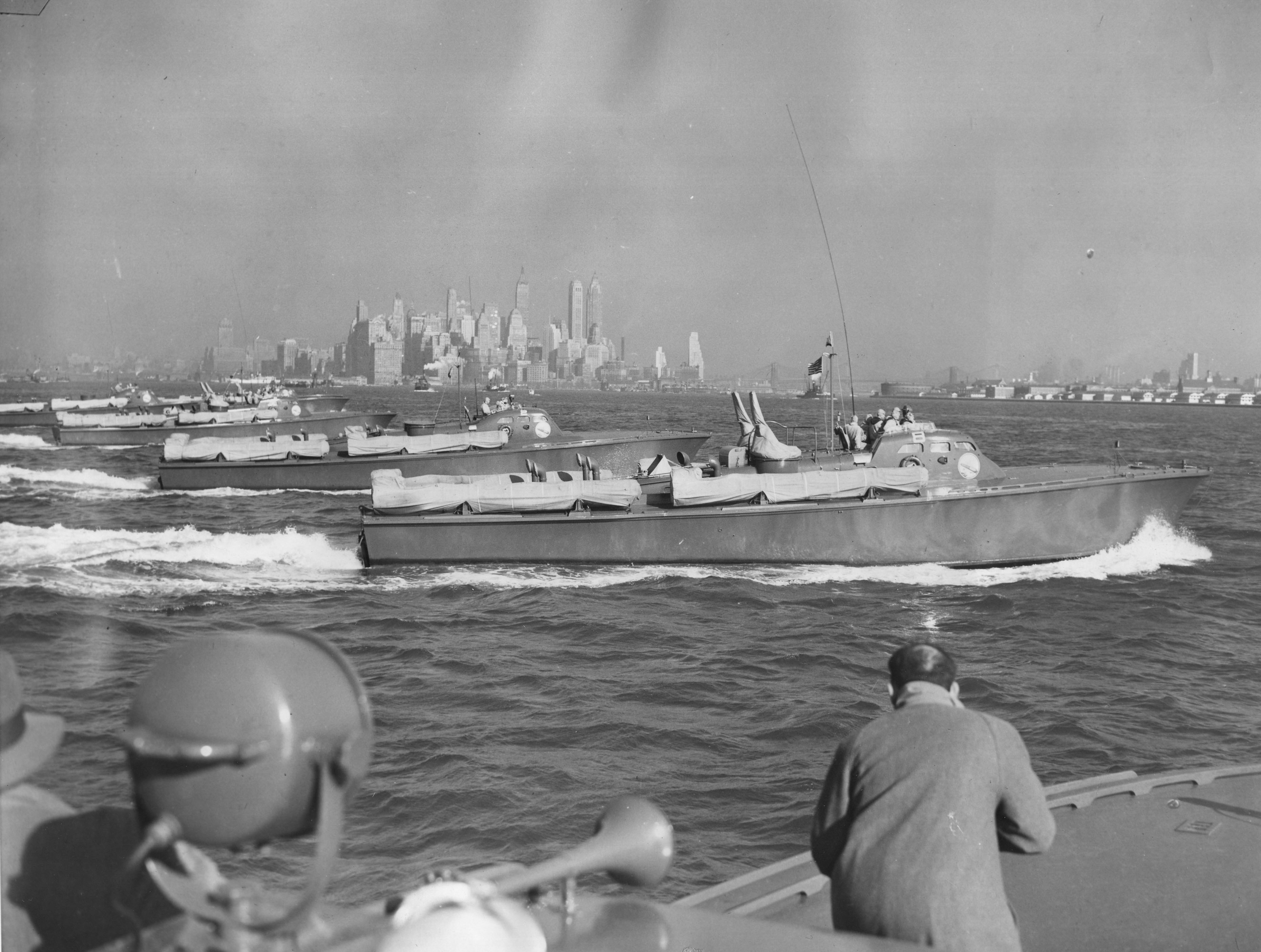
Squadron Two PT's heading out from the New York Navy Yard, November 1941 (Author's Collection)